Tag Archives: FIND A LAWYER

Sydney Legal Help

LEGAL HELPDESK LAWYERS is a new generation private legal practice that offers legal guidance to individuals and businesses in Sydney’s Lower North Shore and Northern Beaches.

We provide information, advice and advocacy to those who need – or might need – legal representation in any area of law.

If required, we refer customers to a reliable network of specialist lawyers. We take the guesswork out of finding a good lawyer.
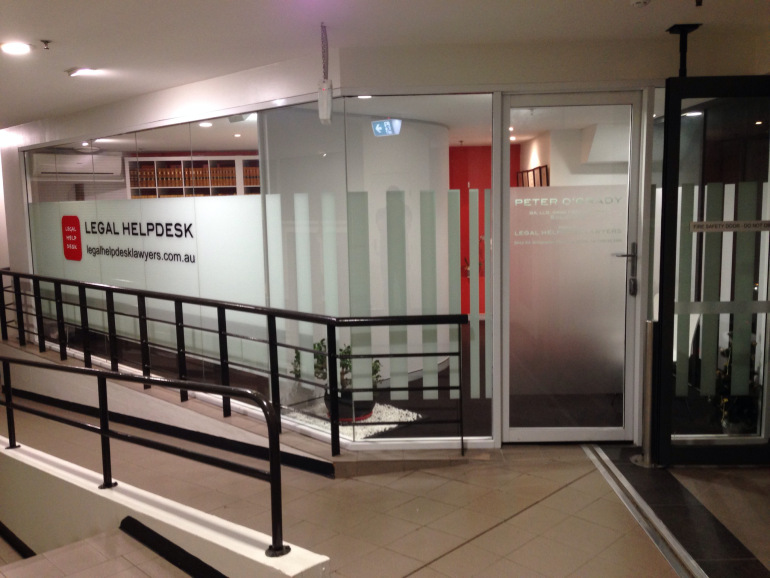
Legal Helpdesk
Legal Helpdesk is at Bridgepoint Mosman near the Level 1 footbridge to Fitness First

Our mission is to promote better local access to good legal help.

Confidentiality and privacy is protected by law.

1300 00 2088

Lawyers

SYDNEY, AUSTRALIA

Lawyers

1300 00 2088

ALL AREAS OF LAW administrative law, advice, advocacy, animal law, arbitration, attorneys, aviation law, banking and finance, bankruptcy, barristers, business law, breach of duty of care, civil liability, civil litigation, commercial law, commercial leases, common law, communications law, company law, compensation, conciliation, consumer law, contract, conveyancing, copyright, corporate law, corporations law, costs, criminal law, criminal litigation, death and disability, debt recovery, defamation law, disability discrimination law, discrimination, dispute resolution, divorce, elder law, employment law, environmental law, equity, estate planning, ethics, family law, guardianship, harassment and workplace bullying, health law, human rights, immigration, industrial law, insolvency, intellectual property, labour law, land and environment court, land law, landlord and tenant, lawyer referral, lawyers, leases, licensing law, liquor law, litigation, local government, malpractice, media law, mediation, medical law, mortgages, motor vehicle law, negligence, occupational health and safety law, partnerships, planning law, powers of attorney, privacy law, pro bono, probate law, professional negligence, professional standards, property law, residential leases, revenue law, securities law, settlements, shipping law, social security, solicitors, sports law, succession, superannuation law, tax law, torts, total and permanent disablement, traffic law, transport law, wills, workplace law

Legal Help in North Sydney

LEGAL HELPDESK LAWYERS is a new generation private legal practice that offers legal guidance to individuals and businesses in Sydney’s Lower North Shore and Northern Beaches.

We provide information, advice and advocacy to those who need – or might need – legal representation in any area of law.

If required, we refer customers to a reliable network of specialist lawyers. We take the guesswork out of finding a good lawyer.

Legal Helpdesk
Legal Helpdesk is at Bridgepoint Mosman near the Level 1 footbridge to Fitness First

Our mission is to promote better local access to good legal help.

Confidentiality and privacy is protected by law.

1300 00 2088

Lawyers

SYDNEY, AUSTRALIA

Lawyers

1300 00 2088

Sydney Lawyers

ON 18 DECEMBER 1906, the High Court of Australia delivered Balmain New Ferry Co Ltd v Robertson [1906] HCA 83; (1906) 4 CLR 379 (18 December 1906).

http://www.austlii.edu.au/au/cases/cth/HCA/1906/83.html

A party who wishes to rely on a contractual term is required to show that it did all that was reasonable to bring term to the other party’s attention.

The plaintiff was not considered to have been falsely imprisoned by the ferry terminal’s turnstiles as he was considered to be free to leave the premises by water.

Lawyers

1300 00 2088

Sydney Solicitors

ON 18 DECEMBER 1906, the High Court of Australia delivered Balmain New Ferry Co Ltd v Robertson [1906] HCA 83; (1906) 4 CLR 379 (18 December 1906).

http://www.austlii.edu.au/au/cases/cth/HCA/1906/83.html

A party who wishes to rely on a contractual term is required to show that it did all that was reasonable to bring term to the other party’s attention.

The plaintiff was not considered to have been falsely imprisoned by the ferry terminal’s turnstiles as he was considered to be free to leave the premises by water.

Lawyers

1300 00 2088

Esanda Finance Corporation Ltd v Peat Marwick Hungerfords (Reg) and Hill v Van Erp [1997] HCA 8 | 18 March 1997

ON THIS DAY IN 1997, the High Court of Australia delivered Esanda Finance Corporation Ltd v Peat Marwick Hungerfords (Reg) [1997] HCA 8; (1997) 188 CLR 241; (1997) 142 ALR 750; (1997) 71 ALJR 448 (18 March 1997) and Hill v Van Erp [1997] HCA 9; (1997) 188 CLR 159; (1997) 142 ALR 687; (1997) 71 ALJR 487 (18 March 1997).

Professional advisors will be liable for economic loss suffered by non-clients in cases where there has been a failure by the advisor to properly perform the duty (eg failing to ensure that audited accounts met accounting standards in Esanda; and failing to ensure that a will was validly signed in Van Erp).

http://www.austlii.edu.au/au/cases/cth/HCA/1997/8.html

http://www.austlii.edu.au/au/cases/cth/HCA/1997/9.html

Lawyers

1300 00 2088

Ex parte Ogden [1893] NSWLawRp 22 | 17 March 1893

ON THIS DAY in 1893 the Supreme Court of NSW delivered Ex parte Ogden [1893] NSWLawRp 22; (1893) 14 LR (NSW) 86.  

Married women and aliens were considered to be under a disability that prevented them from voting in municipal elections.

http://www.austlii.edu.au/au/cases/nsw/NSWLawRp/1893/22.pdf

Lawyers

Sydney, Australia

1300 00 2088

Attorney-General (NSW) v Trethowan [1931] HCA 3 | 16 March 1931

ON THIS DAY IN 1931 the High Court of Australia delivered Attorney-General (NSW) v Trethowan [1931] HCA 3; (1931) 44 CLR 394 ( 16 March  1931).

http://www.austlii.edu.au/au/cases/cth/HCA/1931/3.htm

In 1929, the Constitution Act 1902 (NSW) was amended with the enactment of s7A, which contained a manner and form provision that a bill for the abolition of the NSW upper house (Legislative Council) could not be presented to the Governor for Royal Assent unless the bill was passed by both houses of the state parliament and then approved by a popular referendum.

In 1931, both houses passed a bill for the abolition of s7A and a bill for the abolition of the Legislative Council. The bill for the abolition of the Legislative Council was not approved by popular referendum.

Before the bills could be presented to the Governor for Royal Assent, Trethowan and another councillor obtained a decree from the NSW Supreme Court which in effect restrained the Government from presenting the bills to the Governor. The persons restrained (the defendants) included the NSW Attorney-General, the President of the Legislative Council, the Premier and the other Ministers of the Crown for NSW.

The High Court of Australia dismissed an appeal by the defendants, upholding the validity and binding effect of s7A.

Lawyers

Sydney, Australia

1300 00 2088

Section 10 Crimes (Sentencing Procedure) Act 1998

ON THIS DAY IN 1929, section 10 of the NSW Crimes (Sentencing Procedure) Act 1999 (formerly known as section 556A of the Crimes Act 1900) was added to the Crimes Act 1900 through the passage of the Crimes (Amendment) Act 1929 No 2.

http://www.austlii.edu.au/au/legis/nsw/num_act/ca1929n2189

As at 12 March 2015, s10 provides:

Dismissal of charges and conditional discharge of offender
10 Dismissal of charges and conditional discharge of offender

(1) Without proceeding to conviction, a court that finds a person guilty of an offence may make any one of the following orders:
(a) an order directing that the relevant charge be dismissed,
(b) an order discharging the person on condition that the person enter into a good behaviour bond for a term not exceeding 2 years,
(c) an order discharging the person on condition that the person enter into an agreement to participate in an intervention program and to comply with any intervention plan arising out of the program.
(2) An order referred to in subsection (1) (b) may be made if the court is satisfied:
(a) that it is inexpedient to inflict any punishment (other than nominal punishment) on the person, or
(b) that it is expedient to release the person on a good behaviour bond.
(2A) An order referred to in subsection (1) (c) may be made if the court is satisfied that it would reduce the likelihood of the person committing further offences by promoting the treatment or rehabilitation of the person.
(2B) Subsection (1) (c) is subject to Part 8C.
(3) In deciding whether to make an order referred to in subsection (1), the court is to have regard to the following factors:
(a) the person’s character, antecedents, age, health and mental condition,
(b) the trivial nature of the offence,
(c) the extenuating circumstances in which the offence was committed,
(d) any other matter that the court thinks proper to consider.
(4) An order under this section has the same effect as a conviction:
(a) for the purposes of any law with respect to the revesting or restoring of stolen property, and
(b) for the purpose of enabling a court to give directions for compensation under Part 4 of the Victims Compensation Act 1996 , and
(c) for the purpose of enabling a court to give orders with respect to the restitution or delivery of property or the payment of money in connection with the restitution or delivery of property.
(5) A person with respect to whom an order under this section is made has the same right to appeal on the ground that the person is not guilty of the offence as the person would have had if the person had been convicted of the offence.

Lawyers

1300 00 2088

D’Orta-Ekenaike v Victoria Legal Aid [2005] HCA 12 | 10 March 2005

ON THIS DAY in 2005, the High Court of Australia delivered D’Orta-Ekenaike v Victoria Legal Aid [2005] HCA 12; (2005) 223 CLR 1; (2005) 214 ALR 92; (2005) 79 ALJR 755 (10 March 2005).

The High Court declined to overturn its earlier decision of Giannarelli v Wraith [1988] HCA 52; (1988) 165 CLR 543 (13 October 1988).

The High Court upheld the principle that an advocate is immune from being sued in relation to acts or omissions in the conduct of a case and to work “intimately connected” with work in court. Immunity therefore can extend to advice out of court by an advocate or their instructing solicitor which leads to a decision which affects the conduct of a case in court.

The court held that controversies should be finalised between the parties and not re-opened except in a small number of exceptional circumstances.

Lawyers

1300 00 2088

Australian Safeway Stores Pty Ltd v Zaluzna [1987] HCA 7 | 10 March 1987

NEGLIGENCE. OCCUPIER’S LIABILITY. INJURY. ON THIS DAY IN 1987, the High Court of Australia delivered Australian Safeway Stores Pty Ltd v Zaluzna [1987] HCA 7; (1987) 162 CLR 479 (10 March 1987).

http://www.austlii.edu.au/au/cases/cth/HCA/1987/7.html

An occupier of premises owes a duty of care under the ordinary principles of negligence to take reasonable care for the safety of a person who enters the premises, irrespective of whether they are an invitee, trespasser or licensee.

Per Mason, Wilson, Deane and Dawson JJ at 488:

“We think it is wholly consistent with the trend of recent decisions of this Court touching the law of negligence, both in this area of an occupier’s liability towards entrants on his land and in the areas which were the subject of consideration in San Sebastian Pty. Ltd. v. Minister Administering the Environmental Planning and Assessment Act 1979 [1986] HCA 68; (1986) 68 ALR 161 and Cook v. Cook [1986] HCA 73; (1986) 61 ALJR 25; 68 ALR 353, to simplify the operation of the law to accord with the statement of Deane J. in Hackshaw, at pp.662-663:

‘… it is not necessary, in an action in
negligence against an occupier, to go through the
procedure of considering whether either one or
other or both of a special duty qua occupier and an
ordinary duty of care was owed. All that is
necessary is to determine whether, in all the
relevant circumstances including the fact of the
defendant’s occupation of premises and the manner
of the plaintiff’s entry upon them, the defendant
owed a duty of care under the ordinary principles
of negligence to the plaintiff. A prerequisite of
any such duty is that there be the necessary degree
of proximity of relationship. The touchstone of
its existence is that there be reasonable
foreseeability of a real risk of injury to the
visitor or to the class of person of which the
visitor is a member. The measure of the discharge
of the duty is what a reasonable man would, in the
circumstances, do by way of response to the
foreseeable risk.'”

Lawyers

Sydney, Australia

1300 00 2088