Category Archives: LAW FIRM

Insolvency, Bankruptcy and Winding Up

Insolvency is the inability to pay one’s debts when they fall due.

Insolvent individuals are bankrupted under the Bankruptcy Act 1966 (Cth) whereas insolvent companies are wound up under the Corporations Act 2001 (Cth).

BANKRUPTCY

The Bankruptcy Act 1966 applies to all adult individuals or businesses connected with Australia either through their residence or business.

Bankruptcy may be voluntary of involuntary. An application may be made as long as there is a probable debt.

Bankruptcy applications are made (ie filed) with the Insolvency and Trustee Service, which is the office of the Official Trustee in Bankruptcy who delegates its functions to the Official Receivers and/or registered private trustees.

Voluntary and involuntary bankruptcy

Voluntary bankruptcy is sought by completing and filing a Debtor’s Petition and Statement of Affairs. The Official Receiver may reject such an application if the debtor:

  • would be able to pay their debts in a reasonable time and that the debtor is unwilling to pay the debts and have previously become bankrupt by debtor’s position three or more times or once in the last 5 years.
  • does not reside or carry on business in Australia.

Involuntary bankruptcy is sought by an unpaid creditor or creditors presenting a Creditor’s Petition to the Federal Circuit Court or Federal Court of Australia, subject to their being a judgment and no response to a bankruptcy notice after 21 days since service.

Declaration of bankruptcy

A person is declared bankrupt when a Debtor’s Position is order accepted or a sequestration order is made on a Creditor’s Position.

A declaration of bankruptcy results in the person’s divisible property being put under the control of the Official Trustee or, if requested by the creditor, a private trustee. The divisible property is used to pay the debts.

Divisible property

Divisible property includes: the bankrupt’s interest in land, cash, jewellery, stocks, money owed and most other valuable property.

Divisible property includes property owned as tenants in common with another person, such as a spouse. Property owned separately by a spouse is not included.

If the bankrupt owns property jointly with another person, such as a spouse or business partner, the trustee becomes registered as the tenant-in-common of the bankrupt’s interest in the property.

The trustee cannot take certain property, including:

  • ordinary clothing.
  • household goods.
  • tools of trade up to $3,500.
  • certain insurance/assurance/endowment or annuities, or their proceeds.
  • amounts paid under rural assistance agreements.
  • net equity in motor vehicles up to $7,050.
  • monies received by the bankrupt for damages for personal injury or death, defamation, or property purchased with those monies.
  • superannuation policies, proceeds, lump sums or property purchased with those monies, except for “out of character payments” designed to avoid creditors.

The trustee may also reclaim property given away or sold to others in the 5 years before bankruptcy for less than full value or at any other time if the intention was to defeat creditors.

Income

A bankrupt must also make payments to the trustee out of 50 percent of their income if it exceeds a certain amount.

Restrictions on credit, travel and court proceedings

A bankrupt may not obtain credit for goods or services over $5,040 without advising the provider that they are bankrupt.

The trustee may impose restrictions on the bankrupt’s overseas travel.

A bankrupt may continue or start proceedings relating to personal injury, family death, wrongs to the person (such as defamation) and employment (such as wrongful dismissal or harassment). Other proceedings commenced cannot continue without the approval of the trustee and creditors.

Automatic discharge

A bankrupt is discharged automatically from bankruptcy after three years after filing their Statement of Affairs, unless the trustee objects and seeks an extension of 5 or 8 years.

A bankrupt is released from all outstanding or provable debts after discharge. However, a bankrupt cannot be released from certain debts relating to child support, bonds, fines, proceeds of crime, fraud debts, unliquidated claims, post-bankruptcy debts and student loans and HECS charges.

Annulment

A bankruptcy is annulled when the creditor and trustees have been paid in full or if the creditors accept an offer for less, made through the trustee.

Alternatives to bankruptcy

An insolvent person may avoid bankruptcy if they can satisfy their creditors that they can work their way out of insolvency. Arrangements to effect this include :

  • informal arrangements
  • Part IX debt agreements for small debts, administered by a trustee
  • Part X personal insolvency agreements, administered by a trustee

WINDING UP

The Corporations Act 2001 applies to companies registered in Australia.

Winding up is the process of bringing a company to an end. It is sometimes referred to as liquidation or dissolution. Liquidation specifically means the conversion of assets and inventory into cash to pay the debts whereas dissolution means the ending of the business.

Both solvent and insolvent companies may be wound up. Insolvent companies are wound up when they cannot pay their debts whereas solvent companies are wound up when they no longer serve any useful purpose.

Winding up is not to be confused with receivership. Receivership involves the appointment by a secured creditor of a receiver to collect and sell charged assets to pay the outstanding debt owed to the secured creditor.

Voluntary and involuntary winding up

An insolvent company may be wound up voluntarily or involuntarily.

Voluntary winding up is done by way of resolutions of the shareholders and/or creditors. A company goes into voluntary administration by appointing an external administrator to take control of the company to investigate the affairs of the company and report to the creditors as to whether or not the company be wound up, enter into a scheme of arrangement with the creditors or control be returned to the directors.

Involuntary winding up, or court liquidation, is when the court finds a company to be insolvent and orders that it be wound up, usually following a failure to comply with a Statutory Demand for monies owing.

Statutory Demands are a request by a creditor to a company to pay to their satisfaction an outstanding debt within 21 days. Failure to pay the debt within 21 days results in a presumption that the company is insolvent.

Once an application for winding up has been made, court permission is needed for voluntarily winding up or alteration of the shareholding and membership of the company.

Appointment of liquidator

Once an order for winding up is made, the court (Federal Court of Australia or Supreme Court of a State or Territory) appoints a liquidator.

The liquidator takes control of the company and attends a number of matters including:

  • investigation the company’s affairs and report to ASIC.
  • collection, protect and realise the unencumbered assets and inventory.
  • recovery and sale of property transferred improperly when the company was insolvent.
  • stay of proceedings against the company.
  • implementation of a claims process.
  • implementation of an order of priority for distribution.
  • apply for deregistration after liquidation is completed.

Priority

Priority of payment is to be given to the liquidators (for their costs and expenses), secured creditors, employee entitlements, other unsecured creditors and then shareholders.

Deregistration

At the completion of the liquidation, the liquidator applies for deregistration of the company.

Lawyers

Sydney, Australia

1300 00 2088

Re JRL; Ex parte CJL [1986] HCA 39 | 30 July 1986

ON 30 JULY 1986, the High Court of Australia delivered Re JRL; Ex parte CJL [1986] HCA 39; (1986) 161 CLR 342 (30 July 1986).

http://www.austlii.edu.au/au/cases/cth/HCA/1986/39.html

During a luncheon adjournment, a Family Court counsellor went to the chambers of a judge and had a private conversation in which she expressed certain things including a recommendation that separate representation being granted to the child. Her views were adverse to the husband. Counsel for the parties were then invited to the judges chambers where they were introduced to the counsellor and informed of her recommendations. Comments made by the judge indicated that there had been a private conversation between the counsellor and the judge. After lunch, counsel for the wife made an application seeking appointment of separate representation for the child. The husband asked for the judge to disqualify himself.

The High Court held that it was reasonable for the husband to apprehend that the judge might not bring and impartial or unprejudiced mind to the matter having had a private conversation with the counsellor who had formed an adverse view of him. On that basis, the court made absolute the order nisi for a writ of prohibition directing that the judge be prohibited from proceeding further with the matter.

The case is notable for Justice Mason’s warning that judicial officers are required to discharge their obligations unless disqualified to do so. They must not readily accept suggestions of appearance of bias, otherwise parties might be encouraged to seek their disqualification, without justification, for strategic reasons.

Per Mason J at 352:

“There may be many situations in which previous decisions of a judicial officer on issues of fact and law may generate an expectation that he is likely to decide issues in a particular case adversely to one of the parties. But this does not mean either that he will approach the issues in that case otherwise than with an impartial and unprejudiced mind in the sense in which that expression is used in the authorities or that his previous decisions provide an acceptable basis for inferring that there is a reasonable apprehension that he will approach the issues in this way.

Although it is important that justice must be seen to be done, it is equally important that judicial officers discharge their duty to sit and do not, by acceding too readily to suggestions of appearance of bias, encourage parties to believe that by seeking the disqualification of a judge, they will have their case tried by someone thought to be more likely to decide the case in their favour.”

Lawyers

Sydney, Australia

1300 00 2088

Saaghy v Bunnings Group Ltd [2014] VCAT 951

Saaghy v Bunnings Group Ltd (Civil Claims) [2014] VCAT 951 (29 July 2014)

Lawyers

Sydney, Australia

1300 00 2088

Privacy Concerns about the Opal Card

ON 16 JULY 2014, the NSW Privacy Commissioner issued a media release in response to privacy concerns about the Opal Card.

Under existing privacy laws, law enforcement bodies may access information reasonably required for their investigations. The police will therefore be able to access personal information stored on an individual’s Opal card.

The NSW Privacy Commissioner says that it is important that the police inform the public on the rules for accessing their Opal card information and that Transport NSW has ongoing processes to keep the information secure.

Lawyers 1300 00 2088

Masters Home Improvement Australia Pty Ltd v Bunnings Limited [2014] NZIPOTM 32

Masters Home Improvement Australia Pty Ltd v Bunnings Limited [2014] NZIPOTM 32 (11 July 2014)

Lawyers

1300 00 2088

Spit Junction Lawyers

At Legal Helpdesk we provide legal information and advice to local individuals and businesses on Sydney’s Lower North Shore and Northern Beaches. We triage all types of matters and if required refer them to a network of reliable solicitors and barristers with suitable expertise.

Our aim is to make it easier for people to find the right information, advice and results.

Confidentiality and privacy is protected by law.

1300 00 2088

Lawyers

Sydney, Australia

Connect, follow, like, join, share etc

Legal Helpdesk Legal Helpdesk Legal Helpdesk Lawyers Legal Helpdesk

Sydney Sydney

ALL AREAS OF LAW administrative law, advice, advocacy, animal law, arbitration, attorneys, aviation law, banking and finance, bankruptcy, barristers, business law, breach of duty of care, civil liability, civil litigation, commercial law, commercial leases, common law, communications law, company law, compensation, conciliation, consumer law, contract, conveyancing, copyright, corporate law, corporations law, costs, criminal law, criminal litigation, death and disability, debt recovery, defamation law, disability discrimination law, discrimination, dispute resolution, divorce, elder law, employment law, environmental law, equity, estate planning, ethics, family law, guardianship, harassment and workplace bullying, health law, human rights, immigration, industrial law, insolvency, intellectual property, labour law, land and environment court, land law, landlord and tenant, lawyer referral, lawyers, leases, licensing law, liquor law, litigation, local government, malpractice, media law, mediation, medical law, mortgages, motor vehicle law, negligence, occupational health and safety law, partnerships, planning law, powers of attorney, privacy law, pro bono, probate law, professional negligence, professional standards, property law, residential leases, revenue law, securities law, settlements, shipping law, social security, solicitors, sports law, succession, superannuation law, tax law, torts, total and permanent disablement, traffic law, transport law, wills, workplace law

Road Transport Act 2013 (NSW)

ON 1 JULY 2013, the Road Transport Act 2013 (NSW) commenced.

The object of the Act is to consolidate the provisions of the numerous NSW road transport Acts into the one Act.

Lawyers 1300 00 2088

Pro bono program launched by Fair Work Commission

ON 1 JULY 2014, the Fair Work Commission launched an updated pro bono program in Melbourne. Unrepresented parties in unfair dismissal jurisdictional objection matters will be provided with a free session with a volunteer lawyer in the weeks before their hearing.

Lawyers

Sydney, Australia

1300 00 2088

New Mosman Council DA submission requirements

FROM 1 JULY 2014, only four (instead of six) copies of plans and documents are to be lodged with Mosman Council Development Applications.

http://www.mosman.nsw.gov.au/news/2014/06/30/development-application-submission-requirements

Lawyers 1300 00 2088

Sydney Lawyers

LEGAL HELPDESK LAWYERS is a new generation private legal practice that offers legal guidance to individuals and businesses in Sydney’s Lower North Shore and Northern Beaches.

We provide information, advice and advocacy to those who need – or might need – legal representation in any area of law.

If required, we refer customers to a reliable network of specialist lawyers. We take the guesswork out of finding a good lawyer.

Legal Helpdesk
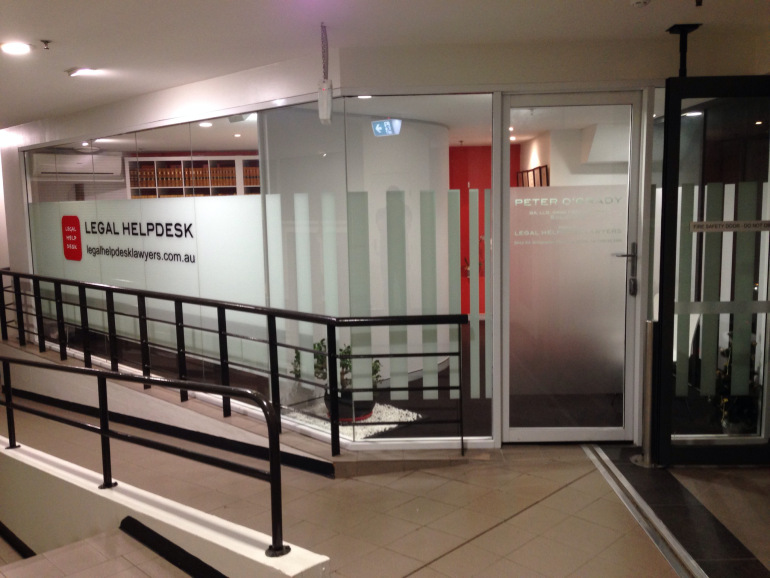
Legal Helpdesk is at Bridgepoint Mosman near the Level 1 footbridge to Fitness First

Our mission is to promote better local access to good legal help.

Confidentiality and privacy is protected by law.

1300 00 2088

Lawyers

SYDNEY, AUSTRALIA

Lawyers

1300 00 2088

ALL AREAS OF LAW administrative law, advice, advocacy, animal law, arbitration, attorneys, aviation law, banking and finance, bankruptcy, barristers, business law, breach of duty of care, civil liability, civil litigation, commercial law, commercial leases, common law, communications law, company law, compensation, conciliation, consumer law, contract, conveyancing, copyright, corporate law, corporations law, costs, criminal law, criminal litigation, death and disability, debt recovery, defamation law, disability discrimination law, discrimination, dispute resolution, divorce, elder law, employment law, environmental law, equity, estate planning, ethics, family law, guardianship, harassment and workplace bullying, health law, human rights, immigration, industrial law, insolvency, intellectual property, labour law, land and environment court, land law, landlord and tenant, lawyer referral, lawyers, leases, licensing law, liquor law, litigation, local government, malpractice, media law, mediation, medical law, mortgages, motor vehicle law, negligence, occupational health and safety law, partnerships, planning law, powers of attorney, privacy law, pro bono, probate law, professional negligence, professional standards, property law, residential leases, revenue law, securities law, settlements, shipping law, social security, solicitors, sports law, succession, superannuation law, tax law, torts, total and permanent disablement, traffic law, transport law, wills, workplace law